
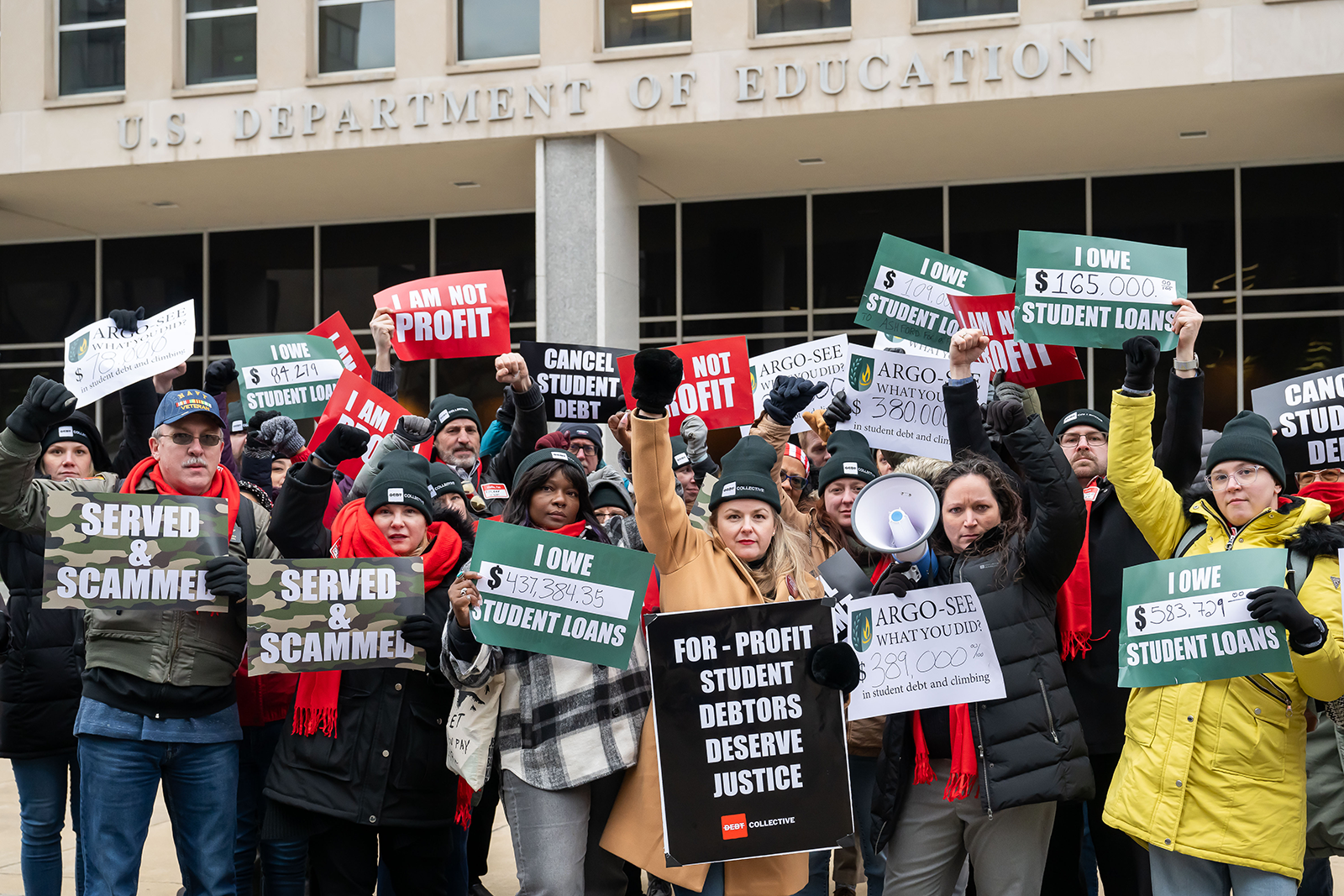
California Borrower Action: Fighting for What You Are Owed
SPECIAL GUEST: Robyn Smith – NCLC
Robyn Smith, a lawyer with National Consumer Law Center will be joining us this evening to talk about your legal rights as a California student loan borrower.
Were you harmed attending a for-profit college in California? California has a law up for renewal right now and what happens next could determine whether you ever see a dollar back.
Join the Debt Collective for a borrower action workshop on California AB 2771 and the 2026 sunset review of the Bureau for Private Postsecondary Education (BPPE), California’s state agency responsible for overseeing private colleges and administering the Student Tuition Recovery Fund.
This is not just an information session. We will walk through our California coalition strategy together, assign action items, and make sure every borrower who shows up leaves knowing exactly what to do next.
This call is open to anyone who attended a for-profit or private school in California, including borrowers who have already had federal loans canceled, borrowers still waiting on Borrower Defense, Sweet v. McMahon class members, and borrowers who have never heard of any of these programs before today.
PRIVATE & FEDERAL LOAN BORROWERS
You do not have to live in California now. What matters is that you enrolled there.
Frequently Asked Questions
What is the BPPE?
The Bureau for Private Postsecondary Education is California’s state-level agency that licenses and regulates private colleges, including most for-profit schools. If you attended a private career school, art school, culinary school, photography school, or graduate psychology program in California, the BPPE almost certainly approved that school to operate.
The Bureau also oversees the Student Tuition Recovery Fund, a California state fund that can reimburse students for financial harm caused by school closures and fraud. It is separate from federal Borrower Defense. It is funded by assessments collected from students at enrollment. In most cases, the schools never told you it existed.
What is a sunset review?
California law requires certain state agencies to go through a periodic review process to prove they should continue to exist. If the legislature does not vote to reauthorize the BPPE through this process, the Bureau could stop operating.
The 2026 sunset review of the BPPE is happening right now. A bill called AB 2771 is the vehicle for reauthorization. A joint hearing before four legislative committees is tentatively scheduled for late June or July 2026. That hearing is where advocates and borrowers can put their stories and their demands directly on the record.
This is a narrow window. It will not stay open long. We need to act now.
Why does the sunset review matter to borrowers?
Because it is the best opportunity in years to change the rules, not just comply with them.
The STRF currently has a four-year filing window. For most borrowers from schools that closed more than four years ago, including Brooks Institute (closed 2016), ITT Technical Institute (closed 2016), and Argosy University (closed 2019), that window has already passed. Most of those borrowers were never told STRF existed. California law required the schools to disclose it. They did not.
The sunset review is the moment to ask the legislature to fix that. We are asking for an amendment to AB 2771 that would treat a federal Borrower Defense approval, the Sweet v. McMahon settlement, or any government designation, like school group cancelation as a trigger that eliminates the four-year window entirely. If the federal government has already found your school defrauded you, California should not turn you away on a technicality the school created.
What is the Student Tuition Recovery Fund?
The STRF is a California state fund administered by the BPPE’s Office of Student Assistance and Relief (OSAR). It was created to reimburse students who lost money when private schools closed or failed to deliver what they promised.
Every student who attended a BPPE-licensed school paid into this fund at enrollment, at a rate of $0.50 per $1,000 in tuition. California law required schools to tell students the fund existed. Most for-profit schools did not. Many borrowers paid into a consumer protection fund for years without ever knowing it was there.
Current eligibility rules limit claims to four years from the qualifying event, typically the school’s closure date. We are organizing to change that.
I already had my federal loans canceled through Borrower Defense or Sweet v. McMahon. Does STRF apply to me?
Possibly, and this is exactly one of the gaps we are organizing to close.
Right now, the STRF’s eligibility framework does not clearly cover borrowers who received federal relief through the Sweet v. McMahon class action settlement or through the Department of Education’s settlement and compromise authority, which is the legal channel used for the Art Institutes automatic discharges in 2024. If you got relief through one of those pathways rather than through an individual Borrower Defense approval, you may currently be excluded from STRF, even though the underlying finding of fraud is the same.
Our amendment ask explicitly covers all three federal discharge authorities: individual Borrower Defense approvals, closed school and false certification discharges, and settlement and compromise discharges. It also covers Sweet class members. If the legislature passes this amendment, having received federal relief would open the door to STRF, not close it.
What can I actually do?
More than you think. Come to this call on June 16 and find out what else is in the plan.
What is happening with federal Borrower Defense right now?
The federal picture is not good, and we are not going to pretend otherwise.
The One Big Beautiful Bill Act, signed July 4, 2025, suspended the stronger 2022 Borrower Defense rules until 2035. The official now overseeing all 452,770 pending federal claims is Nicholas Kent, who was the for-profit college industry’s chief lobbyist against the Borrower Defense program before he was confirmed as Under Secretary of Education in August 2025. The industry’s trade association joined a federal lawsuit in March 2026 seeking to permanently eliminate the program entirely.
California’s Student Tuition Recovery Fund exists precisely because the federal government cannot always be counted on. That is why the sunset review matters. That is why we are here.
I do not live in California anymore. Can I still participate?
Yes. What matters for STRF eligibility is where you were enrolled, not where you live now. If you attended a California-licensed school while living in California at the time, you may qualify regardless of where you are today.
You can also participate in the advocacy campaign from anywhere.
Tuesday, June 16, 2026 – 5:30PM PST / 8:30PM EST
Join Our Monthly Borrower Defense Calls
Stay informed. Get support. Take action.
Our Monthly Borrower Defense Calls are designed for borrowers navigating fraud, misconduct, and student loan injustice. Each call provides timely updates on the Borrower Defense landscape, current litigation, and policy developments—alongside practical guidance on asserting your rights and filing claims.
These calls are both educational and action-oriented. You will have space to ask questions, learn from others with similar experiences, and connect with a community working collectively to challenge predatory student lending.
Throughout the year, we will also host guest speakers from partner organizations, including advocates working in policy, legal aid, and borrower defense support, to share expertise, updates, and opportunities for coordinated action.
Whether you are just getting started or have an open case, these calls are for you.